Define the business before choosing a wellness keyword
Wellness center can describe very different operations: a massage practice, a spa with several personal-care services, a movement studio, or a business that includes clinical care. Those businesses should not share an identical search plan. Begin with an approved inventory of actual appointments, the people delivering them, their relevant credentials, opening hours and the location where each service happens. Mark seasonal, unavailable and planned offerings separately so the website does not sell something reception cannot book.
Ask staff to distinguish the business's name from its service categories. A brand containing wellness does not establish that someone searching for a particular treatment will find what they need there. Conversely, changing the brand to match a broad phrase may create confusion without improving the service information. Google asks businesses to select categories that accurately represent the overall business, rather than treating categories as a list of keywords or every amenity offered.
Choose a concrete initial business objective. A hypothetical Texas center might have available weekday massage appointments while its weekend spa packages are already full. Its first content project could explain the massage appointment and remove booking obstacles. A large collection of general wellness articles would not automatically address that capacity problem. This example illustrates prioritization, not a forecast of search demand or revenue.
Separate wellness center, spa and specific-service intent
Use the words people use when they call, then compare them with existing Search Console queries and the actual results for your service and city. A visitor using a broad wellness phrase may still be exploring. Someone naming a specific service, duration or location may be trying to select an appointment. These are working hypotheses to validate; they are not fixed rules about every searcher. Do not assign search volumes to phrases simply because they sound relevant.
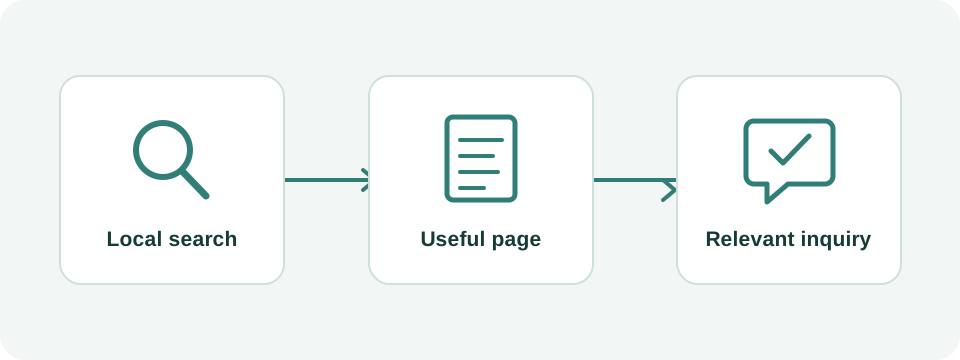
The map below assigns a distinct job to each page. Keep a single primary destination for substantially the same task, and use supporting pages only when they answer a different question. For example, a first-visit guide can explain arrival and preparation while the service page explains what can be booked. Repeating the service introduction on several near-identical pages makes maintenance harder without giving the visitor more useful information.
| Visitor decision | Example search wording | Primary page | Business facts to confirm |
|---|---|---|---|
| Understand the center | wellness center in [city] | Homepage or actual location page | Real service mix, team and location |
| Choose a spa experience | day spa services in [city] | Spa menu or service overview | Available services, durations and booking options |
| Select a specific appointment | [service] appointment in [city] | Dedicated service page | Provider, appointment details and relevant limits |
| Find the correct branch | [business name] [location] | That branch's page | Entrance, contact, hours and branch-specific availability |
| Ask a clinical question | A question about a health condition | Appropriate professionally reviewed education | Relevant expertise, evidence and review responsibility |
Write pages that explain a real Texas appointment
A useful service page identifies the service, who provides it, how the appointment is organized and how a visitor takes the next step. State current prices or explain how a quote is determined; distinguish the scheduled appointment length from hands-on time if your business treats them differently. Use photographs that accurately show your business and describe them honestly. These details answer practical questions that a generic article about relaxation cannot resolve.
Make geography equally concrete. A Houston business should describe its actual address, entrance, parking and relevant access instructions. A Dallas branch needs its own accurate details if it differs. Do not imply that one storefront has locations across Texas, or create a page for every suburb by swapping place names in the same paragraph. A genuine second location can justify a separate page because the visitor has a different destination and potentially different staff or services.
Treat language support as an operating fact. An English–Chinese website can help visitors read the information, but the page should state the language support the team actually provides. Test where each translated booking button goes. If a third-party scheduler is English-only, explain the handoff and provide a real alternative. The accompanying bilingual guide covers that workflow in greater detail.
Keep clinical claims within the right review process
An attractive wellness label does not erase differences between personal-care services and medical procedures. TDLR provides separate guidance for massage therapy and for services offered in medical spas; the Texas Medical Board explains that certain nonsurgical cosmetic procedures are the practice of medicine. Use those official resources to identify the questions the owner and responsible professionals must resolve. A marketing writer should not determine a practitioner's legal scope from a competitor's website.
Maintain a review field for each service page: who approved the service description, which credentials are verified, and which statements require professional evidence. Describing the room, appointment steps or cancellation process is different from promising to diagnose, cure or treat a condition. If a proposed headline introduces a clinical claim, pause it for appropriate review. Do not turn a customer's testimonial into proof that a health outcome will occur.
Google's people-first guidance encourages clear authorship and information that readers can trust, with particular care around health-related subjects. For an owner-focused website, that means showing who actually provides services and keeping factual responsibilities clear. It does not mean inventing a medical reviewer, adding credentials someone does not hold, or attaching a universal medical disclaimer to unsupported sales copy.
Connect the website, Maps profile and booking destination
Give visitors a route from the service overview to the relevant detail page and then to its booking option. Use links whose text describes the destination. Google generally discovers crawlable links through anchor elements with an href attribute, so an interactive design should still provide ordinary navigation links. Ask the developer to demonstrate the actual page and booking path, rather than reporting that the site contains an SEO plugin.
Check the Business Profile's website link, appointment destination, hours and service information against the site. For multiple locations, the selected destination should make the relevant branch obvious. Google describes local visibility through relevance, distance and prominence; adding a Texas phrase to a page cannot eliminate the effect of a searcher's location. Record the location and query when reviewing Maps visibility so that separate observations are not presented as a single universal ranking.
Keep operational ownership simple: identify the person who can edit the website, the profile owner and the booking-system administrator. When a service is removed or hours change, that person should update every affected destination. A new article is a lower priority than an appointment button that still offers a discontinued package.
Measure inquiries that fit the business, then choose the next task
Use Search Console to review relevant queries and landing-page clicks over comparable periods. Keep brand-name searches separate when investigating new discovery. Then record the operational stages you can observe: booking-link clicks, inquiries received, suitable inquiries and confirmed appointments. A click is not an appointment. If the scheduler cannot provide reliable completion data, report that limit and reconcile with aggregated reception records instead of presenting a guessed conversion rate.
For a hypothetical review period, suppose a service page receives relevant visits but reception reports repeated questions about duration and branch availability. The next task is to clarify those details and check the correct booking destination. If inquiries concern a service the center does not offer, inspect the wording attracting those visitors. Those decisions are more useful than celebrating total traffic without checking whether the business can serve it.
Texas is an important client market for Wintra. We help owners turn their service information into an English or bilingual website and a practical search plan. Bring your business name, address, current service menu and the booking problem you want to solve; an existing website is helpful but not required. The next step is a written scope linking the work to your actual operations, not a guaranteed ranking.