What makes a Brooklyn local service SEO plan useful?
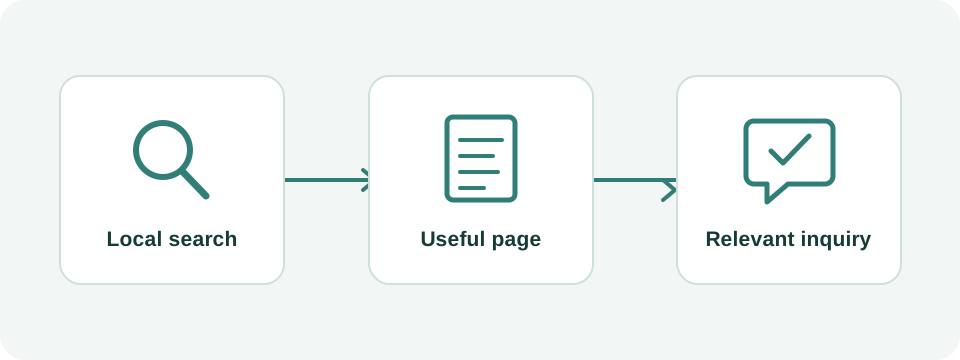
Brooklyn local service SEO works best as a page-planning problem: choose a clear page for each service, describe where the business operates, and make the inquiry process easy. Add neighborhood pages when they provide distinct help. A long list of place names cannot replace details that let a customer decide whether the service fits.
The right structure depends on how the business operates. A salon with one storefront needs directions and appointment information. A cleaning company that travels to customers needs coverage and job requirements. A clinic needs an accurate location and booking path. Do not copy the same navigation across these businesses just because all three serve Brooklyn.
Begin with the questions customers ask before they contact you: do you do this work, do you serve this address, what should I expect, and how do I get started? Give each question a home. That simple map is a useful defense against a website that expands every month while becoming harder to use.
Separate service intent from neighborhood coverage
A service page explains a buying decision. A neighborhood page explains meaningful local availability or location details. A project page demonstrates completed work. These roles can overlap, but each URL should have a primary purpose. If two pages both try to answer the same question for the same audience, decide which should lead.
Consider a hypothetical cleaning business that handles recurring apartment cleaning and move-out cleaning. Those services involve different preparation and scope, so separate service pages may help. The same business serving Park Slope and Sunset Park does not automatically need two near-identical cleaning pages. Start with coverage information and add local pages only when you can answer a distinct need.
Use the following worksheet before adding a URL. It is a planning example, not a prescribed architecture for every business. The decision should remain understandable to someone who knows the business but has never used an SEO tool.
| Proposed page | Publish when | Otherwise |
|---|---|---|
| Move-out cleaning | Scope and preparation differ from recurring cleaning | Explain the option within the main service page |
| Park Slope service page | Distinct availability, project evidence, or customer instructions exist | Add accurate coverage to the service-area overview |
| Second staffed location | It is a real location with its own practical visitor information | Do not imply a branch exists |
| Project example | You can explain actual work and have publication permission | Gather evidence before publishing |
| Chinese-language service page | The audience needs it and the business can support that journey | Resolve content and inquiry support first |
Write around the information needed to book
Lead with the exact service and whom it suits. Explain inclusions, exclusions, preparation, how estimates or appointments work, and what happens after a request. A useful page lets a customer disqualify themselves as well as contact you. Fewer unsuitable inquiries can be a better result than more calls that your team cannot serve.
Use local operating details where they matter. For an on-site service, building access, appointment windows, or what the customer must arrange may be relevant if those are your actual policies. A storefront may need entrance details and directions. Do not invent neighborhood characteristics or claim special expertise simply to make a page sound local.
Keep one primary inquiry action visible on mobile. Explain whether the visitor is requesting a quote, booking a confirmed slot, or asking for a callback. Those are different commitments. After submitting the form, the confirmation should say what happens next. Test the form yourself and verify the receiving inbox instead of assuming a successful screen means delivery worked.
Audit overlapping pages before publishing more
Create an inventory with one row per live service or area URL. Record its main customer question, preferred search intent, actual evidence, inquiries if known, and planned action. Start with the pages the business links from its navigation. A small inventory that leads to decisions is more valuable than an exhaustive crawl nobody reviews.
For each pair of similar pages, ask whether a customer would understand why both exist. Keep both when their purposes are distinct and the content proves it. Merge them when the distinction exists only in the title. If a page has earned useful links or search visibility, plan the consolidation carefully: choose a relevant destination, redirect the old URL, and update internal links.
Do not call every repeated keyword a ranking conflict. Related pages can naturally discuss the same service. The concern is unclear ownership of the same intent, especially when each page is thin. Google's doorway policy is another reason to avoid batches of substantially similar place-name pages. Review usefulness and structure together rather than setting an arbitrary page-count target.
Represent locations and languages accurately
The website and Business Profile should describe the same real operation. A business that travels to customers should not invent a Brooklyn storefront to appear closer to them. Google's profile rules require accurate representation, while its service-area guidance distinguishes businesses that receive customers from those that visit them. Use the applicable model before planning location pages.
Language support also needs operational truth. If you publish a Chinese service page, make sure prices, coverage, preparation, and contact instructions agree with the English version. Decide who handles Chinese-language inquiries and how the visitor selects a language. A translated heading followed by an English-only booking process may leave the most important part of the journey incomplete.
Treat language and neighborhood as separate planning dimensions. Some customers in a neighborhood prefer English; others may prefer another language. Let actual inquiries and customer knowledge guide content. Do not assume everyone in a named area reads the same language, or that a language page can replace an accurate explanation of service coverage.
Give customers a reason to choose this business
Distinctive content usually comes from the operation. Ask the owner which inquiries are most difficult to answer, which jobs require preparation, and why customers choose one option over another. Turn the answers into useful service information. This produces more practical detail than asking a writer to add another paragraph about Brooklyn's vibrant neighborhoods.
Use evidence with a clear origin: approved photos, an accurately described project, a named team member's experience, or a documented service process. Avoid anonymous success stories with unexplained numbers. If you cannot verify a performance claim, publish the decision process or a clearly labeled hypothetical example instead of presenting it as a client result.
For a hypothetical move-out cleaning page, a scope table could distinguish inside-cabinet cleaning, appliance interiors, and tasks that require separate agreement. The exact rows must come from the company. Such detail can prevent misunderstandings before a booking; its value does not depend on claiming that a table is a special ranking factor.
Measure page usefulness with a small, consistent report
Choose the primary service page and record a baseline period before substantial edits. Use Search Console to inspect the page's queries and website search clicks. Keep brand-name searches separate from service-discovery searches when the available data permits. A rise in existing customers searching the business name answers a different question from new demand for a service.
Then review inquiries with your team. In a hypothetical comparison, one page receives 100 visits and 8 suitable inquiries while another receives 300 visits and 3 suitable inquiries. The useful-inquiry rates are 8% and 1%. This does not prove the first page ranks better or that its design caused the difference; it tells you which journey deserves a closer look.
Record changed hours, seasonal demand, campaigns, and service capacity alongside the numbers. When inquiries are few, one large project can distort a monthly revenue comparison. Read the actual inquiry notes before rewriting the page. Sometimes the next improvement is a clearer exclusion, a better contact route, or a faster reply rather than a new neighborhood article.
Publish a smaller plan you can maintain
For the first month, pick one valuable service, improve its page, correct its contact path, and connect it to relevant evidence. Review the service-area wording and remove claims the business cannot support. Assign an owner to check the information whenever hours, coverage, team, or booking policies change. Fresh dates without substantive review do not solve outdated facts.
Use the next review to choose between a second service page, a useful area page, and consolidation of older content. The right answer depends on what the first page and inquiry log reveal. Keep a short change log so the business understands what shipped and can connect future decisions to the actual website.
Wintra can help a Brooklyn business turn that inventory into a focused site and local SEO scope. Send the website, services you want to grow, real coverage or storefront location, and the questions customers keep asking. We can discuss a structure that your team can keep accurate as the business changes.