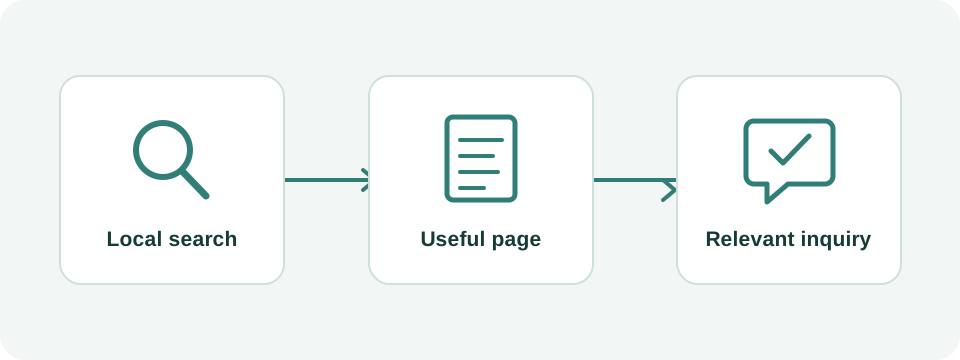
Separate language demand from a New York address
A business can serve Chinese-speaking customers without operating in a predominantly Chinese-speaking neighborhood. It can also have a Flushing address while receiving many English-language searches. Build the plan from the business's actual customers, capacity, and service area. A borough name is a geographic fact; it is not proof of a customer's language preference or the phrases they type into search.
Interview whoever answers the phone. List the services callers ask for, the places they travel from, the languages they request, and the questions that prevent them from booking. Then inspect the site's existing query and landing-page reports. Treat a third-party keyword export as an estimate of observed rankings, not a complete demand census. Missing Chinese phrases in an English-heavy export do not prove that no Chinese-speaking audience exists.
Decide what the business can support now. If English phone calls are handled reliably but Chinese messages wait several days, adding a prominent Chinese inquiry path creates an operational task as well as a content task. Assign its owner before launch. The best initial page set is the one that connects search demand with a service the team can deliver and an inquiry it can answer.
Build an intent map instead of translating a keyword list
For each service, write down what a searcher is trying to accomplish: find a nearby provider, compare options, understand cost, or prepare for an appointment. Match that task to an existing page before commissioning a new one. A restaurant's menu page, a contractor's estimate page, and a clinic's first-visit page have different jobs even if all three need English and Chinese versions.
Use the worksheet below to choose a primary destination for each intent. The examples illustrate decisions, not verified keyword volumes or promises of ranking. One strong service page may answer several wording variations. Create a separate page only when the reader needs materially different information, such as a genuine second location with different access instructions and staff.
Keep both language names in the editorial brief, but do not insist on word-for-word headings. Ask a fluent reviewer how a local customer would ask the question naturally. Preserve concrete facts, service boundaries, and the next action. This avoids a common failure: a technically translated page that answers an agency's keyword list rather than the customer's decision.
| Reader task | Preferred page | Local evidence | Useful success signal |
|---|---|---|---|
| Find a provider nearby | Service or real location page | Address or service area; actual availability | Relevant calls or directions requests |
| Check language support | Staff or contact page | Named language availability and contact process | Answered language-specific inquiries |
| Compare cost and scope | Pricing explanation or quote guide | Included work, exclusions, estimate process | Better-qualified quote requests |
| Prepare before visiting | First-visit or access guide | Entrance, transit, parking, required steps | Fewer repetitive access questions |
Use a small bilingual SEO structure the team can maintain
For one US business, keeping English at the root and Chinese under a directory is a straightforward editorial arrangement. Google recommends distinct URLs for language editions. A language switch should open the equivalent page, not discard the visitor's context. Maintain a page-pair list so that newly published content cannot silently become disconnected from its counterpart.
Google's language-alternative guidance requires reciprocal annotations and a self-reference for each version. Apply an appropriate canonical within the same language, and keep internal links consistent with that choice. These signals help describe the site's organization; they do not replace a useful page, create local relevance by themselves, or promise a particular result position.
Use Chinese script labels that match the actual content. If the team produces only Simplified Chinese, do not present it as a separate professionally reviewed Traditional Chinese edition. If both are needed, establish who maintains each and whether the audience needs substantive differences. A menu of unsupported language options makes the website look more complete while giving the owner more unfinished work.
Make New York details specific enough to help someone act
Local usefulness comes from the details a visitor cannot obtain from a generic national article. Describe the correct building entrance, suite, nearby transit stop, parking arrangement, service boundary, or appointment policy when the business can verify it. For a mobile service, explain where the team actually travels and any scheduling constraints. Do not invent storefronts or office addresses to fill a neighborhood page template.
Consider a hypothetical Queens accounting office serving clients in person and online. A useful location page could explain its actual office access, appointment languages, and which services can begin remotely. Separate pages for every nearby neighborhood would add little if the office, staff, process, and advice were identical. Start with the real office and link to service explanations that help visitors decide whether to contact it.
Keep Google Business Profile information consistent with the business's real-world identity. Google's representation rules ask businesses to use the name they actually use and to avoid unnecessary additions. A bilingual SEO campaign is not a reason to append a list of Chinese services or neighborhoods to the profile name. Use the website's descriptive copy for those explanations where they accurately describe the business.
Assign translation ownership and test the complete inquiry
Choose one person to approve factual changes and one reviewer for each language. They can be the same person if they have the relevant knowledge. Store approved business facts separately from promotional wording, so a new phone number or policy change can be applied across the site. Before publishing an article, record its intended reader, the question answered, source links, and the service page it supports.
A bilingual website review should include the less visible states: an invalid form entry, the thank-you message, an unavailable appointment, a closed office, and an email reply. Read the site on a phone and follow the primary task without relying on the desktop menu. Verify that Chinese characters display correctly and that longer translated labels do not cover buttons or disappear off-screen.
For regulated professional services, the relevant professional should review claims, titles, and required wording. For any business, remove claims the team cannot substantiate. An English disclaimer does not repair an overstatement in Chinese. If only one edition can be approved by the launch date, release the approved pages and keep the unfinished edition out of navigation until it is ready.
Read bilingual SEO results by intent and page group
Search Console provides query, page, country, and device views alongside clicks, impressions, click-through rate, and average position. Use comparable date ranges and separate the English and Chinese landing-page groups. Country does not identify language, and Chinese characters in a query do not identify a person's ethnicity or location. Interpret those clues cautiously and focus reporting on what the business needs to improve.
Create a short review sheet for each important page pair: indexing state, relevant queries, clicks, inquiry actions, and the team's assessment of inquiry quality. If the English service page attracts irrelevant traffic, revise its focus before translating more variations. If the Chinese page attracts relevant visits but staff cannot answer the resulting messages, fix response ownership before increasing promotion.
Use a first review to identify missing information and technical defects, then a later review to look for sustained demand patterns. The timing should reflect the site's actual data volume; a handful of visits cannot establish a reliable conversion trend. Keep a dated change log so a traffic movement can be compared with what changed, rather than automatically credited to the latest article.
Wintra's bilingual website and SEO services can turn this map into an implementation scope: which pages need rewriting, which language pairs are missing, who supplies factual review, and how inquiry tracking will be checked. That written scope is a more useful buying decision than a package promising a fixed number of translated keywords or guaranteed first-place rankings.