Build bilingual acupuncture website SEO around real patient questions
A patient searching in English may want to understand what happens at a first acupuncture appointment. A Chinese-speaking visitor may already know the treatment name but need to confirm whether the practitioner speaks Mandarin or Cantonese. Neither assumption applies to everyone. Ask reception staff which questions they repeatedly answer, then turn those questions into a page brief. Separate the language a person reads from the language they want to speak during an appointment.
Start with the decisions a visitor must make: whether the clinic offers the relevant service, who provides it, where the appointment happens, what the first visit involves, and how to contact the team. Record the verified answer and its owner before drafting. If insurance participation or a practitioner's schedule is uncertain, the page should explain how to confirm it rather than fill the gap with a reassuring but unverified promise.
For a hypothetical clinic in Flushing, the launch set might contain a homepage, acupuncture service page, practitioner biography, first-visit guide, and contact page in each language. This is an example scope, not a recommended minimum page count. If the clinic cannot review all five pairs, publish a smaller complete journey first. An abandoned Chinese booking path is more damaging to the visitor's experience than a modest, accurate website.
Use a page-pair worksheet before you translate
Give every proposed page a single purpose and a corresponding destination in the other language. The English and Chinese versions should answer the same core decision, while examples and explanations can change to make sense to each reader. Maintain one shared fact sheet for the business name, address, telephone number, practitioner credentials, service availability, fees, and policies. That keeps translation work from becoming a second, contradictory source of operational information.
The worksheet below illustrates a planning process for a fictional clinic; the paths are examples, not pages on this site. Fill the final column with a real person's name. For the first-visit page, ask that reviewer to follow every instruction on a phone. A beautifully translated paragraph is unfinished when its appointment button lands on an unexplained form in another language.
| Page purpose | English / Chinese path | Facts to keep aligned | Review owner |
|---|---|---|---|
| Understand acupuncture visits | /acupuncture/ /zh/acupuncture/ | Service scope, practitioner, next step | Treating practitioner |
| Check clinician credentials | /team/ /zh/team/ | Name, credentials, actual languages | Practitioner or practice manager |
| Prepare for a first visit | /first-visit/ /zh/first-visit/ | Arrival instructions, forms, cancellation policy | Reception lead |
| Choose how to book | /contact/ /zh/contact/ | Phone, hours, booking destination | Person handling inquiries |
Give each language a stable URL and a working return path
Google recommends separate URLs for language versions. A simple English root and Chinese /zh/ directory is practical when one US clinic serves both audiences. Keep the page available without requiring a visitor to select a language first. Provide a visible language link on each paired page, and let people choose; a browser preference does not reliably describe the language they want for a healthcare conversation.
Use hreflang to identify equivalent language pages, including each page itself and its counterpart. The pair must link back through those annotations. A Chinese translation should not point its canonical tag at the English version merely because English was written first; use the appropriate same-language canonical. These are separate jobs: alternate annotations describe language relationships, while canonicalization identifies the preferred URL within a duplicate set.
Test a concrete journey after implementation: open the English service page, switch languages, open the practitioner profile, and return to English. Record any switch that sends the reader to the homepage or loses the intended service. Also check the page title, primary heading, navigation, image descriptions, and contact confirmation. Untranslated interface fragments often survive after the main paragraphs have been reviewed.
Review clinical meaning and service language separately
Create a short terminology sheet for the services the clinic actually provides. Record the English term, approved Chinese wording, explanation for a first-time visitor, and the practitioner who reviewed it. Include acupuncture, any separately offered modalities, appointment types, and professional titles. A translation that sounds polished can still turn a limited statement into a broad health promise or imply a credential the practitioner does not hold.
Ask the practitioner to review meaning rather than simply approve the page's tone. Does a sentence describe the clinic's process, summarize evidence, or promise an outcome? Those statements need different support. For example, describing how the practitioner discusses a patient's goals is an operational statement; saying a treatment cures a condition is a clinical claim. Do not turn testimonials into evidence of a treatment's effectiveness. The FTC's health advertising guidance explains why implied claims and testimonials also require attention.
Be equally exact about spoken-language support. A bilingual website does not establish that every clinician speaks both languages or that an interpreter is always available. State the actual arrangement, including how to request language assistance. Preserve the same limits in both editions. If a service changes, update the shared fact sheet and both pages before leaving the older translation visible.
Keep booking usable without collecting unnecessary health details
The language journey continues beyond the website. Check whether the appointment platform has a matching language option, whether required fields are understandable, and what happens after submission. If the booking provider is English-only, explain that before the visitor clicks and provide a real alternative, such as calling the office during its stated hours. Do not label an English-only booking form as Chinese booking.
Use a routine contact form only for the information the team needs to respond. Keep medical history, symptoms, uploaded records, and treatment notes out of general marketing forms and analytics events. A practical event label describes the action, such as booking-link click, without including the visitor's typed message. Review the full route from form to inbox to any third-party platform, because the visible page alone cannot establish how information is handled.
For clinics subject to HIPAA, whether tracking is permissible depends on the information involved and how it is used or disclosed. HHS guidance contains important distinctions and a notice about a court ruling affecting part of the guidance. Have the clinic's privacy adviser assess the actual configuration; an SEO vendor should not call a website HIPAA-compliant just because it uses HTTPS or a familiar scheduling product.
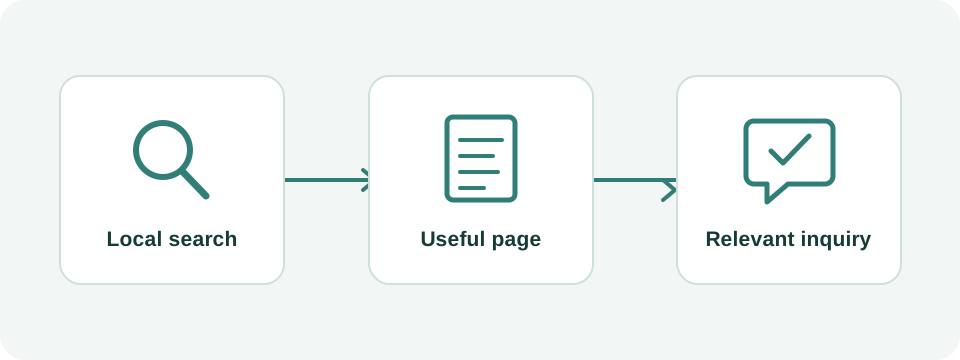
Measure each language's path from discovery to inquiry
Make a page inventory at launch and mark which English URLs have a reviewed Chinese counterpart. Record the publication date, current reviewer, booking destination, and next review trigger. A fee change, practitioner departure, or new office hours should trigger an update; a date on the page should reflect a real review, not a scheduled cosmetic refresh.
Use Search Console to inspect queries, landing pages, impressions, and clicks. Compare the language directories over the same dates, then examine individual page pairs. A query's characters are only a clue to language intent, and sitewide average position cannot explain whether the Chinese contact path works. Add operational feedback: which page did callers mention, which language did they request, and which unanswered questions delayed booking? Keep that feedback aggregated and free of patient details.
When impressions grow but inquiries do not, inspect the landing page's relevance and booking handoff before publishing more articles. When the English pair performs and the Chinese pair does not, review translation completeness, internal links, and indexability rather than assuming a lack of demand. Wintra can help plan the bilingual structure and website implementation; the clinic remains the source of truth for services, credentials, and clinical review.